

A WorkCover claim rejected by your employer’s insurer isn’t the end of the road. You’ve been hurt at work, you lodged a claim, and the answer was no. That’s a hard letter to read, particularly if you’re off work and the bills keep arriving.
In WA, a “not accepted” decision can be challenged through a process run by WorkCover WA that has no application fee. The timelines inside that process are strict, so it helps to know the steps early. This guide covers what the decision notice means, how to dispute it, how conciliation and arbitration work, and when a lawyer can help.
Can You Appeal a Rejected Workers Compensation Claim in WA?
Yes, you can challenge it, but you don’t appeal to WorkCover WA. First, you ask the insurer to reassess its decision. If that doesn’t settle things, you can apply to WorkCover WA’s Workers Compensation Conciliation Service. If conciliation doesn’t resolve the dispute, you can apply for arbitration, where an arbitrator makes a binding decision.
The names cause confusion. Most people say “WorkCover” for the whole system, but in WA, WorkCover WA is the government regulator. You claim through your employer, and your employer’s insurer (or self-insurer) decides the claim.
That’s why there’s no internal appeal to WorkCover WA. What it does run are the conciliation and arbitration services that deal with disputes.
What a “Claim Not Accepted” Decision Means
Once you give your employer a completed claim form and a certificate of capacity, your employer has seven days to lodge both with its insurer.
The insurer then has 14 days to give you either a liability decision notice or a deferred decision notice. WorkCover WA uses the words “not accepted” where most people say “rejected”.
| Decision | What it means | What happens next |
| Accepted | The insurer accepts the claim. | Weekly income compensation if your injury stops you working, plus reasonable medical and health expenses. |
| Not accepted | No compensation is paid, and the insurer must tell you why. | You can ask the insurer to reassess. If that fails, you can apply to WorkCover WA’s Conciliation Service. |
| Deferred | The insurer needs more information before deciding. | It must give a liability decision notice before the provisional payments day, which is the day after 28 days from receiving the claim. If it doesn’t, provisional payments become payable. |
| Neither a liability decision notice nor a deferred decision notice within 14 days | The insurer is taken to have accepted liability. | Your employer is liable for income compensation and medical and health expenses from your injury. |
| Deferred, then no decision within 120 days | The claim is taken to have been accepted. | Same as above. |
Why an Insurer Might Not Accept a Claim
The notice has to give a reason, and that reason tells you what to work on. The points an insurer can raise follow what the scheme requires:
1. Whether You’re A “Worker”.
The definition covers full-time, part-time, casual, seasonal, piece and commission workers. Working directors, contractors and sub-contractors may also count, depending on their working arrangements. Volunteers generally aren’t covered.
2. Whether The Injury Or Disease Is Work-Related.
WA’s scheme is no-fault, so you don’t have to show your employer did anything wrong. You do need to be a worker with an injury or disease that arises from your employment, which can include an injury away from your workplace while you’re acting on your employer’s instructions, and that needs medical treatment or time off.
3. Whether The Paperwork Is Complete.
A claim is made once you’ve given your employer a completed claim form and a certificate of capacity from your doctor.
4. Whether The Claim Was Made In Time.
A claim must be made within 12 months after the injury occurs. The Act says a late claim isn’t invalid if the delay results from mistake, absence from the State or another reasonable cause, or if it wouldn’t prejudice the employer’s defence. If you’re near the 12-month mark or past it, get advice quickly.
A reason for the notice is the insurer’s position, not the final word. That’s what the dispute process is for. If you haven’t lodged a claim yet, our guide to personal injury claims in WA explains how workers’ compensation claims start.
How to Dispute a Workers Compensation Decision in WA: Step by Step
A rejected claim is disputed in stages, starting with the insurer.
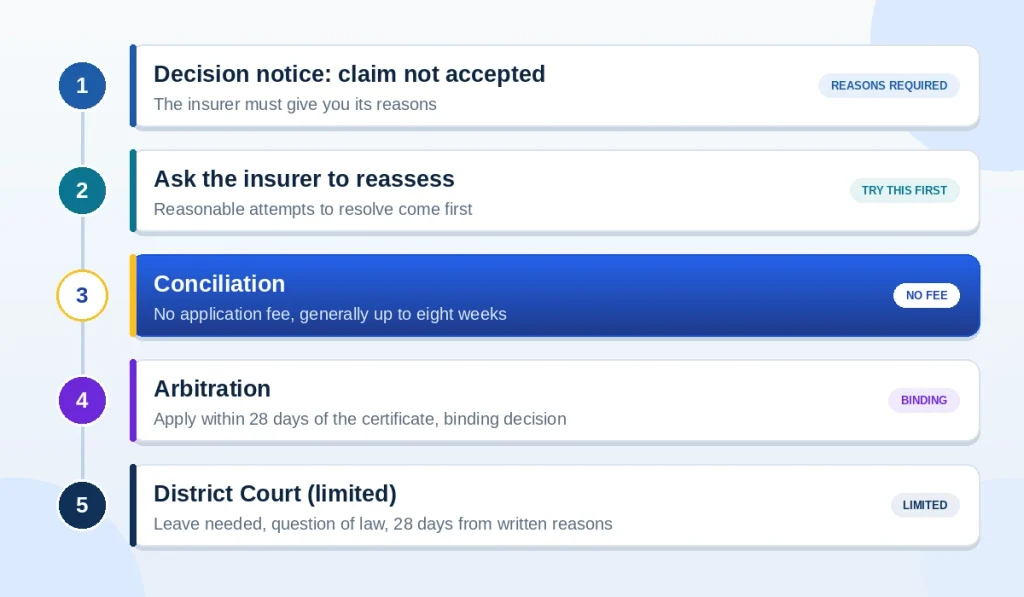
The path in order: ask the insurer to reassess, apply for conciliation, move to arbitration if it isn’t resolved, and only then a limited appeal to the District Court. Each step is explained below.
Step 1: Read the Decision Notice Carefully
Find the reason the insurer gives and write down the date you received the notice. Keep a copy. Everything that follows depends on that reason.
Step 2: Gather Your Evidence
Start collecting before you contact anyone. Useful items include:
- Your claim form and First Certificate of Capacity. WorkCover WA says to keep copies of both.
- Later medical certificates and reports from your treating doctor or specialists.
- Any report from a medical examination the insurer arranged. The insurer must give you a copy within 14 days of receiving it.
- The insurer’s decision notice, and any emails or letters between you and the insurer about it.
- Anything showing how the injury happened: an incident report, witness names, photos, rosters, emails, your job description.
- A simple diary of symptoms, time off work and costs.
Step 3: Ask the Insurer to Reassess
WorkCover WA says you can approach the insurer to reassess its decision. It also expects reasonable attempts to resolve the dispute before it will take a conciliation application. A short letter or email to the insurer, with any new evidence attached, leaves a clear record that you tried.
The conciliation application form asks for the dates, the people involved, and what you did to try to resolve the dispute, with copies of emails or letters attached, so keep all of it.
Step 4: Get Free Information, or Legal Advice
WorkCover WA’s Advice and Assistance Service gives guidance and support to workers and employers. You can call it on 1300 794 744, 8.30 am to 4.30 pm on weekdays, and it can help you complete a conciliation application. Whether to bring in a lawyer is covered further down.
Step 5: Apply for Conciliation
Any party to a claim can apply. As a worker, you must already have submitted a claim and a First Certificate of Capacity to your employer. Applications go through WorkCover WA Online, so you’ll need to register for an account first.
If you’re an unrepresented worker, you can choose not to use the online system and lodge the Application for Conciliation form by email, in person at WorkCover WA’s office at 2 Bedbrook Place, Shenton Park, or by post. There’s no application fee.
WorkCover WA’s published guidance doesn’t set a cut-off date for lodging, but it warns that strict timelines and limited opportunities apply. Don’t wait.
Step 6: Go to Arbitration If Conciliation Doesn’t Resolve It
Conciliation ends with a certificate of outcome. You can only apply for arbitration once that certificate has been issued (or the Director of Conciliation has certified the dispute as unsuitable for conciliation).
The application must be lodged within 28 days of the date the certificate was issued, and the other side has 14 days from being served to lodge a reply.
If you miss the 28 days, the Registrar can extend the time on application if satisfied there are extenuating circumstances, and WorkCover WA has an application form for this. Ask for advice quickly rather than relying on an extension.
Arbitration is formal. An arbitrator, who is a legal practitioner, hears the evidence and makes a decision that is binding on the parties.
Step 7: Appeal to the District Court (Limited)
An arbitrator’s decision can be appealed to the District Court of Western Australia, but only with the court’s leave and only where a question of law is involved.
Where compensation is in dispute, the Act generally requires the amount at issue in the appeal to be at least $5,000 and at least 20% of the amount awarded, unless the court considers the matter important enough that, in the public interest, an appeal should lie.
An application for leave must be made within 28 days of the date you were given the arbitrator’s written reasons. Disagreeing with the outcome isn’t enough on its own, so this is the stage where legal advice matters most.
Timeframes at a Glance
| Stage | Timeframe |
| Employer lodges claim with insurer | 7 days |
| Insurer gives a decision notice or deferred notice | 14 days from the insurer receiving the claim |
| Provisional payments day (deferred claims) | Day after 28 days, counted from the day the insurer receives the claim |
| Claim taken to be accepted (deferred, no decision) | 120 days from the day the insurer receives the claim |
| Conciliation conference | Usually within 28 days of the application being accepted |
| Conciliation overall | Generally no longer than 8 weeks |
| Arbitration application | Within 28 days of the certificate date |
| Reply to arbitration application | 14 days from being served |
| Application for leave to appeal to the District Court | Within 28 days of the written reasons |
The WorkCover WA Conciliation Process Explained
Conciliation is a negotiated process, not a hearing. A conciliator, who is independent, impartial and trained in dispute resolution, helps the worker and the insurer try to reach agreement. It can happen quickly by phone, but it’s usually a conciliation conference held in private.
Both sides present their position and evidence. Documents are due at least three days before a conference, unless the conciliator directs otherwise.
A conciliator can’t advise either side how to present their case or negotiate. They can point out risks, outline best and worst case scenarios, and give a non-binding opinion on the likely outcome if an arbitrator decided the matter.
They also have limited power, in appropriate cases, to make interim directions, for example to pay, suspend or reduce income compensation, or to pay medical and health expenses.
WorkCover WA says most disputes are resolved at conciliation. If yours isn’t, the conciliator issues a certificate of outcome and the arbitration step becomes available.
Do You Need a Lawyer for a Disputed WorkCover Claim?
Not legally. You can use a legal practitioner or authorised agent, but you don’t have to. WorkCover WA notes that employers and insurers often have representation, which is worth weighing up.
A lawyer can help work out what the insurer’s reason actually turns on, identify missing medical evidence, keep track of deadlines and present your case at conciliation or arbitration.
Legal fees in these proceedings are subject to the Workers Compensation Legal Profession and Authorised Agent Costs Determination.
WorkCover WA says it sets a costs scale intended to encourage early settlement, with maximum hourly rates set by legislation. Before engaging anyone, ask what you’ll be charged and what’s covered.
Getting Help with a Rejected Claim
For free information about the process, call WorkCover WA’s Advice and Assistance Service on 1300 794 744 between 8.30 am and 4.30 pm on weekdays.
If you’d like a lawyer to read your decision notice and talk through your options, you can book an initial consultation with us at Hoe Lawyers. Our office is at Level 5, Adelaide House, 200 Adelaide Terrace, East Perth WA 6004, and you can call 08 6244 5234.
This article is general information only and isn’t legal advice. Get advice about your own situation.
FAQs
How Long Does the Insurer Have to Decide My Claim?
The insurer must give you a liability decision notice or a deferred decision notice within 14 days of receiving the claim. If it gives neither, it’s taken to have accepted liability. If it defers and then doesn’t give a liability decision notice within 120 days of receiving the claim, the claim is taken to have been accepted.
Does It Cost Anything to Apply for Conciliation?
No. WorkCover WA charges no fee for applications to the Conciliation Service or the Arbitration Service. Using a lawyer or authorised agent is optional, and if you do, their fees are subject to the Costs Determination, which sets a costs scale and maximum hourly rates for this type of work.
How Long Does Conciliation Take?
WorkCover WA says conciliation generally takes no longer than eight weeks, and that a conference is usually scheduled within 28 days of the application being accepted. The Conciliation Rules set the limit at 56 days after the application is accepted, and the Director can extend it, on the conciliator’s request, by up to a further 56 days.
Can I Be Paid While My Claim Is Disputed?
If your claim was not accepted, no compensation is paid. A conciliator can make limited interim directions in appropriate cases, such as for income compensation or medical expenses. Provisional payments are different: they apply when an insurer defers a claim and hasn’t made a decision within 28 days of receiving it.
What If I Miss a Deadline?
Get advice straight away and don’t assume it’s too late. For arbitration, the Registrar can extend the 28-day deadline on application if there are extenuating circumstances. Other deadlines may work differently, so call WorkCover WA’s Advice and Assistance Service on 1300 794 744 or speak to a lawyer about your situation.